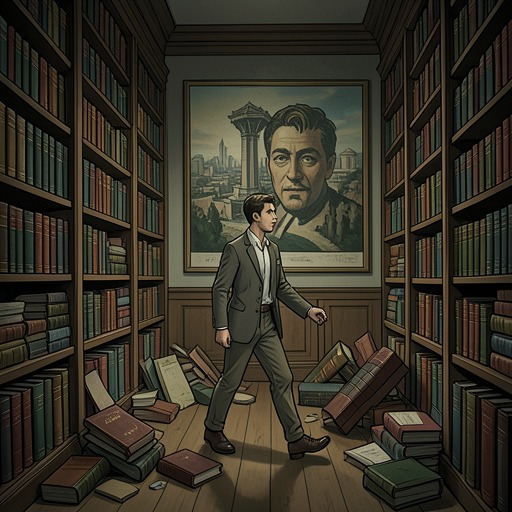
Maester Aemon’s Death
A Feast for CrowsMaester Aemon’s Death is presented not as a sudden interruption but as the final narrowing of a long life devoted to service, memory, and restraint. Aemon Targaryen recognizes that he will not reach Oldtown, confronts the fear beneath his old age and illness, and dies before the Citadel’s healers can be consulted. His passing closes the watch of a man who could once have been king, yet chose the crown for his younger brother and spent his remaining life at the Wall. Through Samwell Tarly’s mourning and Aemon’s last interpretation of the dragon prophecies, the event links personal grief to the possible return of forces believed lost to history.
Final Illness and Acceptance
Aemon’s last conversation with Samwell Tarly begins with physical decline and the old man’s recognition that this illness will not pass. When Sam promises that he will recover, Aemon rejects the reassurance and says that he will not see Oldtown again. He understands death as imminent rather than abstract: the Stranger waits outside his door, and the prospect of joining his dead brothers and father forces him to examine what may lie beyond death. The certainty does not make him serene. He wonders whether death brings the sweet release promised by septons or only cold, darkness, and pain beyond the wall of death. Aemon’s fear is made visible through his weakened body. His fingers tremble, and his memories arrive through fever, dreams, and uncertainty. He asks why the gods took his eyes and strength yet allowed him to linger so long, frozen and forgotten, and what use they could have for an old man. The question gives his final hours the character of an existential reckoning: the life of duty has not answered why he was preserved, and his approaching death makes that unanswered question unavoidable.
Dragons, Memory, and Prophecy
The immediate revelation of Aemon’s final reflections is his continued memory of dragons. He calls them the grief and glory of his House, although the last dragon died before Sam’s birth. Aemon insists that he sees them in dreams: a red star bleeding in the sky, shadows moving across snow, leathery wings, and hot breath. His brothers also dreamed of dragons, and those dreams killed them all. The memories therefore carry both wonder and menace, joining dynastic magnificence to a history of destruction. Aemon remains unsure whether his visions preserve prophetic knowledge or merely reflect the fever of a dying old man. He places the present at the edge of half-remembered prophecies and wonders whether living people are trembling before wonders and terrors beyond their comprehension, or whether he is simply feverish. That hesitation matters: his final insight is not offered as uncomplicated certainty, but as a perception caught between revelation and bodily collapse. He also regrets leaving the Wall. He believes that he should have understood the danger of departing and recalls the opposing forces expressed in the maxim that fire consumes while cold preserves. Yet he knows that returning is impossible. His remaining act of service is to send Sam to the ships to learn everything he can about the dragons. Even at the threshold of death, Aemon turns memory into a task for the living.
Death Before Oldtown
On Braavos, Aemon briefly appears capable of recovery. Talk of dragons seems to restore him, and he eats every bite Sam puts before him. That temporary strengthening makes the later death more painful because it creates the possibility of rescue without fulfilling it. Aemon is determined enough to walk onto the Cinnamon Wind under his own power after Sam secures passage, but the journey cannot carry him safely to Oldtown. Aemon’s final prophetic reconsideration changes his understanding of the promised figure. He remembers how he and others had searched for a male prince, first associating the prophecy with Rhaegar Targaryen and later with Rhaegar’s son. The error, he concludes, entered through translation: dragons are neither permanently male nor female, but changeable as flame. From that corrected reading, he identifies Daenerys Targaryen as the one born amid salt and smoke, with her dragons serving as confirmation. The discovery gives him a final purpose he cannot complete. He wishes he were ten years younger and declares that he must go to her, but age and illness leave him unable to pursue the conclusion he has reached. Aemon’s death consequently carries a sharp contrast between intellectual awakening and physical failure. His mind reaches toward a new historical possibility at the very moment his body can no longer follow it. Sam has sacrificed possessions and sold books to pay for passage, hoping to get Aemon to Oldtown, but the effort cannot prevent the loss. The books, intended for the Citadel, become part of the price of a journey that ends short of its destination, while Aemon retains his maester’s chain rather than surrendering the visible sign of his vows.
Funeral and Legacy
Samwell Tarly conducts the funeral aboard the Cinnamon Wind, somewhere off the southern coast of Dorne, because no septon is present to lead the prayers. Wearing his black clothing, Sam initially calls Aemon a good man, then corrects himself: Aemon was a great man, a maester of the Citadel, chained and sworn, and a sworn brother of the Night’s Watch. The correction establishes the terms by which Aemon will be remembered. His greatness lies not solely in royal blood or prophetic knowledge, but in the endurance of a life bound to counsel, learning, and service. Sam’s eulogy recalls that a dozen lords commander came and went during Aemon’s years at the Wall, while Aemon remained to counsel them. He also counseled kings and could have been a king himself, but gave the crown to his younger brother. The funeral therefore restores the full scale of the life that illness had reduced to a frail old body: Aemon was a Targaryen, a potential ruler, a keeper of memory, and a servant who chose obligation over sovereignty. Sam closes by naming him Aemon Targaryen and declaring that his fire has gone out and his watch has ended. Gilly repeats the final words, and the crew echoes them in the Common Tongue and the Summer Tongue. The ceremony thus moves beyond the Night’s Watch without abandoning its language. The Summer Islanders, who had known Aemon only briefly, honor him through their own custom by drinking rum in memory of the old blind dragon. Their response gives the death a communal form: Aemon’s life is received not only by those who shared his vows, but also by strangers who recognize age, dignity, and loss.
Narrative Significance
The event makes death both an ending and a transmission. Aemon cannot reach Oldtown, cannot meet Daenerys Targaryen, and cannot test his revised understanding of the prophecy himself. What remains is his instruction to Sam, the memories lodged in his final speech, and the ritual language that allows the living to carry him forward. His death does not resolve the meaning of the dragons; it places that meaning into the hands of those who survive him. Aemon’s passing also gathers several competing forms of mortality into one scene. His life has been preserved by vows, his body has been weakened by age, and his mind is haunted by the vanished dragons of his House. Other deaths in the wider narrative are represented through drowning, violent mutilation, peaceful sleep, failed mercy, or resurrection, but Aemon’s death is shaped by conscious preparation, fear, recollection, and witness. He faces the Stranger without pretending that faith has erased uncertainty, while Sam’s funeral converts private devastation into a public remembrance. The decisive change is therefore not only that Aemon dies, but that historical knowledge changes hands. The old man’s final correction of the prophecy gives Daenerys and her dragons a new place in the story, while Sam’s words preserve Aemon as more than the remnant of a fallen dynasty. His watch ends, but his counsel, questions, and interpretation survive as an inheritance for a world entering an uncertain age of dragons.